
the cushion between the bones. Reports describe its height and whether it bulges or herniates.
MRI Decoder
Tap structures on a cervical MRI view to learn the plain language twin and what reports usually mean.
Educational only. This map explains patterns doctors commonly describe. It is not a diagnosis, and it does not replace a review of your own MRI by a physician.
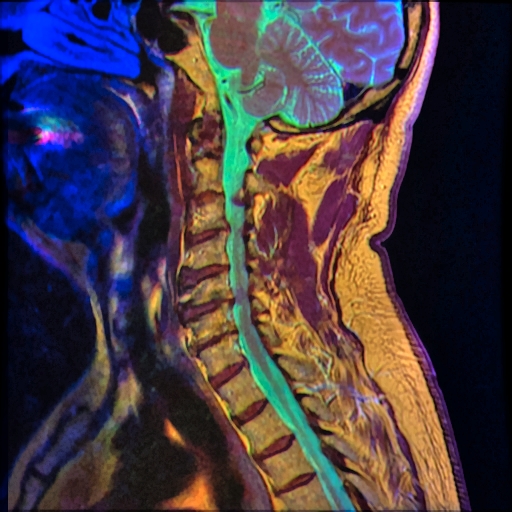
Select a structure on the MRI views.
How reports grade narrowing
MildA little less space than usual.
ModerateClearly less space; often watched closely with your symptoms.
SevereMuch less space. Still describes the image, not automatic surgery.
Grades describe space, not pain, and many people with severe looking images feel fine while others with mild images hurt.
Disc
- What reports usually mean
- Reports describe its height and whether it bulges or herniates.
Vertebra
- What reports usually mean
- Reports note alignment and bone quality.
Spinal cord
- What reports usually mean
- Reports describe whether anything touches or presses it.
- Sounds scary, usually means
- the report is checking whether the cord has room, not diagnosing a stroke of the spine.
Thecal sac
- What reports usually mean
- "Effacement" means something presses into the sleeve.
- Sounds scary, usually means
- less space around the sleeve, graded by how much room remains.
Nerve root
- What reports usually mean
- Reports may note whether a root looks contacted or compressed at a level.
Foramen (neural foramen)
- What reports usually mean
- "Foraminal narrowing" or "stenosis" means the doorway is tighter, often from disc or joint wear.
- Sounds scary, usually means
- a tighter doorway. Many people have mild narrowing without severe symptoms.
Facet joint
- What reports usually mean
- Wear here is arthritis of the spine, and it can narrow the foramen.
Ligamentum flavum
- What reports usually mean
- It can thicken with age and narrow the canal from behind.
Central canal
- What reports usually mean
- "Stenosis" means the tunnel is narrowed; reports grade it mild, moderate, or severe.
- Sounds scary, usually means
- less room in the tunnel. Grades describe space, not how much you hurt.
one of the stacked bones. Reports note alignment and bone quality.
the main cable (cervical and thoracic). Reports describe whether anything touches or presses it.
the fluid filled sleeve around the cord and nerves. "Effacement" means something presses into the sleeve.
the branch leaving the cord at each level, the wire for one pattern on Map 2. Reports may note whether a root looks contacted or compressed at a level.
the doorway each nerve exits through. "Foraminal narrowing" or "stenosis" means the doorway is tighter, often from disc or joint wear.
the small joint at the back that guides motion. Wear here is arthritis of the spine, and it can narrow the foramen.
a ligament at the back of the canal. It can thicken with age and narrow the canal from behind.
the tunnel the cord and nerves travel in. "Stenosis" means the tunnel is narrowed; reports grade it mild, moderate, or severe.