
Fusion vs. artificial disc replacement, explained
A careful framing
This article explains concepts only. It does not recommend surgery, name who is a candidate, or promise results. Many people never need an operation. Decisions belong with you and your surgeon.
What fusion means in plain language
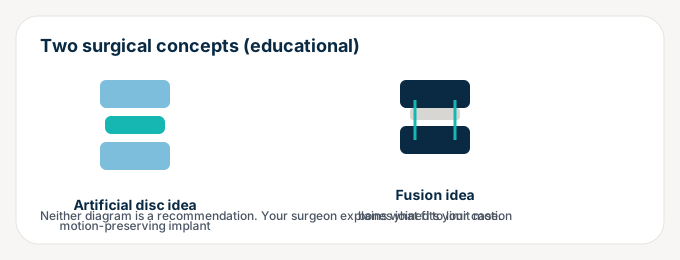
Spinal fusion joins two or more vertebrae so that segment moves less. Surgeons may use bone graft and implants. The goal in selected cases is stability and symptom relief when other care is not enough. Fusion changes motion at that level.
What artificial disc replacement means
Artificial disc replacement places a device meant to keep some motion at a disc level after the damaged disc is removed. It is used in selected situations and is not appropriate for every pattern of disease.
Why comparisons are personal
Anatomy, prior surgery, bone quality, alignment, and your symptoms all matter. What helped one person may not apply to you. Ask your surgeon how they weigh options for your case.
Questions worth asking
Why this option for me, and why not the other? What recovery looks like in practical terms? What are known risks you want me to understand? What happens if we continue nonsurgical care for now?